Lifting a house moves the plumbing into the weather and the flood
Plumbing under a raised house runs through open air, and federal flood rules limit what can stay down there. Parking, building access and storage are the listed uses below the flood level. Fixtures and appliances belong above it.
Compiled from the sources listed at the end. Sources checked .
For houses raised or built up on pilings, in all our towns.
What moved when the house went up?
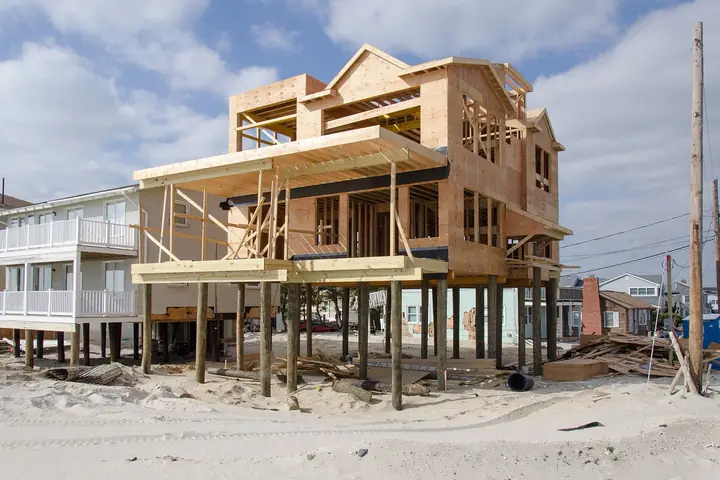
The floor moved, and every line that serves it had to follow. Water and drain lines that once made a short trip now travel from the ground up to a floor several feet higher, often past nothing but posts or block. The same is true of a house built new on pilings, like the ones FEMA photographed going up in Beach Haven on Feb. 6, 2013.
FEMA's plumbing Fact Sheet 3.4.3 makes a handy list of what to find on your own house: drinking water system, water heater, sewer lateral, drain, waste and vent piping, and any backwater valve. Stand at the bottom of the stairs and try to trace each one. If you cannot say where one goes, that is your first question for a plumber.
What may sit below the flood level?
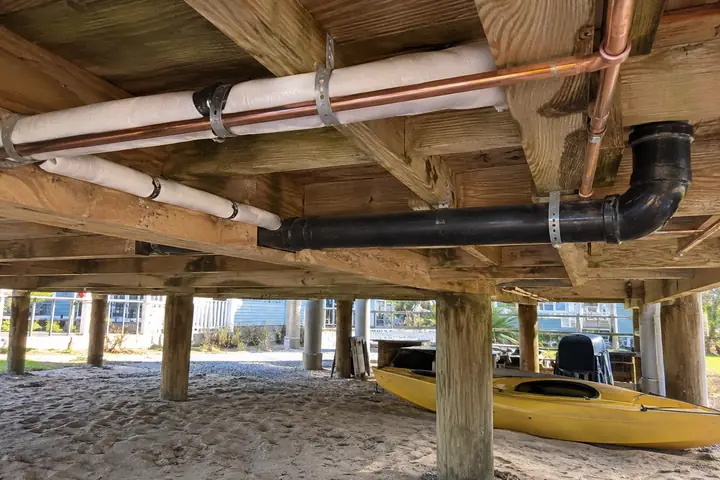
Three uses, on the federal wording. 44 CFR 60.3(c)(5) says enclosures below the lowest floor in a flood zone are "usable solely for parking of vehicles, building access or storage," and they must let floodwater in and out. That is why the walls have flood openings.
FEMA's coastal construction manual, P-499, tells builders to keep utilities out of enclosures below the DFE, and not to finish those spaces. DFE is the Design Flood Elevation, the height a house is designed to.
| Item | What the document says | Document |
|---|---|---|
| Parking, access, storage | The listed uses for an enclosure | 44 CFR 60.3(c)(5) |
| Appliances, heating and cooling equipment, plumbing fixtures | "not allowed below the BFE" | Region 7 advisory |
| Electrical | Only if needed for life safety | Region 7 advisory |
| Utilities in enclosures | Do not install below the DFE | P-499 |
| Equipment kept below | Only if built to "prevent water from entering or accumulating" | P-348 |
FEMA P-499 (2010), FEMA P-348 (2017), FEMA Region 7 advisory (2016) and 44 CFR 60.3, read in 2026
Why quote a document written for Iowa?
Because it states the federal idea plainly. FEMA Region 7 wrote its advisory on elevating building utilities after the 2016 Iowa floods. BFE there means Base Flood Elevation. It was not written for Barnegat Bay, and this story does not quote New Jersey's own flood hazard rule. Your town's floodplain office is the place to hear how the rules apply to your lot.
What is different about lines left exposed?
They meet weather the old walls kept off. Three things go to work on them:
- Cold. A line in open air has less around it than a line in a wall. See freezing pipes.
- Salt. FEMA treats corrosion as a coastal materials issue; our brief on salt air has the references.
- Water. FEMA P-348 describes Zone V as "subject to inundation as well as wave heights of 3.0 feet and higher." A line under a house in that zone can meet moving water.
Risk to the water service line is a question for your plumber and your water utility.
How high did Sandy put the water?
Up to several feet above ground. The National Hurricane Center report gives a range of 3 to 5 feet of storm tide above ground for Ocean County, puts landfall near Brigantine on Oct. 29, 2012, and says water reached 4 to 5 feet in places that included Tuckerton and Long Beach Island. Anything set at grade where the water reached that height went under.
What should you ask the construction office?
Bring these, for a house in Toms River, Brick, Lacey, Waretown, Barnegat, Stafford or on Long Beach Island alike:
- What is the flood elevation for this lot, and what does the town count as below it?
- Is anything of mine, such as a heater, softener or laundry hookup, in a spot the rules do not allow?
- Does moving this line need a plumbing permit? State rule 5:23-2.14 makes permits the default, with exceptions for ordinary maintenance and emergency work. Our permit story goes through the list.
- Were the elevation and the plumbing work closed out with final inspections?
Who touches what?
A New Jersey licensed master plumber handles permit plumbing. N.J.A.C. 5:23-2.15 reserves plumbing work for licensed people, and makes one exception, for owners of a single-family house working on their own dwelling. Choosing that plumber gets its own story.
Also asked
Can I finish the space under my raised house?
FEMA P-499 says not to finish enclosed areas below the DFE. The federal rule lists parking, access and storage as the uses. Ask the construction office before spending money down there.
Does a laundry hookup count as a plumbing fixture?
FEMA's Iowa advisory says plumbing fixtures are not allowed below the BFE, so put the question to your town before adding or keeping one.
Is my sewer lateral at risk on a raised house?
FEMA P-348 says drain, waste and vent piping can carry floodwater, and it names a valve on the lateral as one protection. Our backwater valve story covers it.
Where can I find what is true on my own street?
Start with the town pages in this site for the water system, then the construction office for the flood elevation.
Who to ask
- Your municipal construction office: permit history for your address, and whether a line move needs a permit.
- Your town's floodplain office: the flood elevation for your lot, and what may stay below it.
- New Jersey Consumer Affairs: the state's license verification page, to check a plumber's license.
- Your water utility: who owns the line from the street to the house.
Where this comes from
- 44 CFR 60.3 - allowed enclosure uses and flood openings (text on Cornell's Legal Information Institute).
- FEMA P-499, Home Builder's Guide to Coastal Construction, 2010 - no utilities or finished enclosures below the DFE.
- FEMA Region 7, Flood Protection and Elevation of Building Utilities, Iowa Floods 2016 - appliances, fixtures and electrical below the BFE.
- FEMA P-348, 2017 - equipment below the BFE, Zone V, floodwater in drain piping.
- FEMA P-2181 Fact Sheet 3.4.3 - primary plumbing components.
- NOAA National Hurricane Center, Sandy report AL182012 - landfall and Ocean County storm tide.
- NJ DCA Historic Trust, Superstorm Sandy slides, June 3, 2022 - displaced residents and top gust; conference slides, not a damage report.
- N.J.A.C. 5:23-2.14 - permit rule (text on Cornell's Legal Information Institute).
- N.J.A.C. 5:23-2.15 - licensed work and the homeowner exception (text on Cornell's Legal Information Institute).