Where the water heater goes once the house goes up
The water heater location on a raised house belongs above the flood level unless your town says otherwise. FEMA warns that heaters set at grade or lower flood easily, and its 2017 book covers elevation or specially designed equipment. Your construction office applies the rule to your lot.
Compiled from the sources listed at the end. Sources checked .
For houses raised or built up on pilings, in all our towns.
What does FEMA say about a heater at grade?
It says the heater floods. A FEMA Region 7 advisory from the 2016 Iowa floods describes water heaters built at grade or lower as "highly susceptible to flood damage," and it lists appliances as "not allowed below the BFE." BFE means Base Flood Elevation. It was written for Iowa, so ask your town's floodplain office how it reads here.
FEMA P-348, the agency's 2017 book on protecting building utilities, names the domestic water heater as a primary plumbing component and covers elevating it.
Can a heater stay below the flood level?
Only under a narrow condition. P-348 says the National Flood Insurance Program lets equipment stay below the Base Flood Elevation only if it is built to "prevent water from entering or accumulating." Ask your plumber and construction office whether any unit you are shown meets that test. Do not take a sales sheet's word for it.
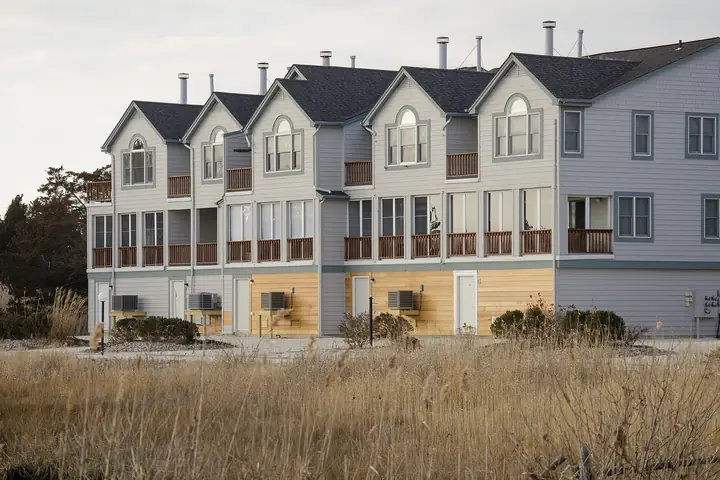
A closet or room on a living floor is the obvious place to ask about. FEMA's photographs from Mystic Island on Feb. 6, 2013, show townhouses repaired after Sandy, their air conditioners and meters set up on stands.
Does replacing a water heater need a permit?
Assume yes until the construction office says otherwise. New Jersey's list of ordinary plumbing maintenance covers faucets, valves, traps and like-for-like fixtures. Water heater replacement is not on that list. The permit rule makes it unlawful to install regulated equipment without a permit outside its exceptions. Emergency work may start first, with notice as soon as practicable and an application within 72 hours. Whether a dead heater qualifies is for the office to say.
Our permit story runs through the rest. The same office can tell you whether a replacement must move up, especially if your heater now sits below the flood level. Ask before you buy.
What temperature should it be set to?
120 degrees. The Consumer Product Safety Commission "urges all users to lower their water heaters to 120 degrees Fahrenheit" to cut the risk of scalds. If the dial is hard to reach or you are unsure, ask your plumber on the next visit.
What about the relief valve and its pipe?
Leave the valve alone. It is a safety device that lets pressure out of a heated tank. Never block it or try to fix it, and do not test it yourself. If you see a drip, a stain, or a discharge pipe that was shortened, moved or disconnected when the house was lifted or the heater was moved, call a licensed plumber and say what you saw.
Who may work on a gas heater?
A licensed professional, every time. Gas work on a raised house is off the homeowner list in this site, whatever the homeowner exception in N.J.A.C. 5:23-2.15 allows for plumbing on your own single-family dwelling. Hiring a New Jersey licensed master plumber is the plain path, and New Jersey Consumer Affairs runs the page where the state lets you verify a license.
What should you ask before the new one goes in?
| Question | Who answers | Why |
|---|---|---|
| What is the flood elevation here, and where is the heater relative to it? | Construction or floodplain office | Sets whether it can stay |
| Does this replacement need a permit and inspection? | Construction office | It is not on the ordinary maintenance list |
| Is this unit designed to keep flood water out? | Plumber, in writing | P-348's condition for staying below |
| Where will the relief discharge go? | Plumber | A safety line that must stay working |
| Will it be set at 120°F? | Plumber | CPSC's scald number |
Built by this site from FEMA P-348 (2017), FEMA Region 7 advisory (2016), CPSC and N.J.A.C. 5:23-2.14, read in 2026
A floor-level heater brings its own question: what happens if it leaks over a finished room? Drain pans are the part usually discussed. Your plumber can say whether one suits your layout and where it would drain.
Also asked
Can I keep the old heater in the enclosure until it dies?
We found nothing that settles this for an existing unit. FEMA's advisory says appliances are not allowed below the BFE, so ask the construction office about your house and its permit history.
Does a tankless heater change the flood question?
The questions stay the same: where it sits relative to the flood level, how it is protected, and what the permit says.
Is a water heater part of a plumbing system under FEMA's list?
Yes. FEMA's plumbing Fact Sheet 3.4.3 names it among the primary components, along with drinking water systems and sewer laterals.
How do I keep a raised heater's pipes from freezing?
Lines running up to a heater in open air face the same cold as the rest. Our freezing pipes story has the Red Cross steps.
Who to ask
- Your municipal construction office: whether your replacement needs a permit, and where it may go.
- Your town's floodplain office: how high the flood level runs at your address.
- A New Jersey licensed master plumber: the unit, the location and the relief discharge.
- Your gas utility: gas service questions, and any gas smell, from outside the house.
Where this comes from
- FEMA Region 7, Flood Protection and Elevation of Building Utilities, Iowa Floods 2016 - heaters at or below grade, appliances below the BFE.
- FEMA P-348, 2017 - the water heater as a primary component, elevation, the condition for equipment below the BFE.
- CPSC, Tap Water Scalds - the 120°F setting.
- N.J.A.C. 5:23-2.7 - ordinary plumbing maintenance (text on Cornell's Legal Information Institute).
- N.J.A.C. 5:23-2.14 - permits and emergency work (text on Cornell's Legal Information Institute).
- N.J.A.C. 5:23-2.15 - licensed work and the homeowner exception (text on Cornell's Legal Information Institute).
- New Jersey Natural Gas, Smell Gas - leave first, then call from a safe location.
- NOAA National Hurricane Center, Sandy report - Ocean County storm tide.