Before you hire, find out which license the job actually calls for
Hiring a plumber or well driller in New Jersey starts with matching the job to the license. Permit plumbing calls for a licensed plumber, wells for a driller of the proper class, and septic design for a professional engineer. As of January 2023, the state reported "no State regulations for water treatment professionals."
Compiled from the sources listed at the end. Sources checked .
For any Ocean County house, in all our towns.
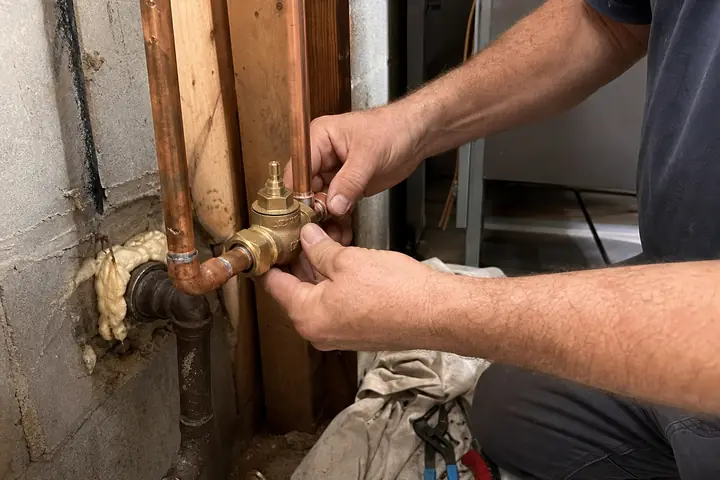
The licenses are separate, and a good plumber is not automatically the right person for a well. This site does not rate or recommend anyone, and it names no local firms. What follows is what state rules name, and what you can ask.
Who does which job?
Each kind of work has its own named professional in state rules, and the table sets them side by side.
| Job | Who the rule names | Rule |
|---|---|---|
| Plumbing work under a permit | Licensed plumber; homeowner exception on own single-family dwelling | N.J.A.C. 5:23-2.15 |
| Well drilling and pump installing | Drillers and pump installers licensed under N.J.S.A. 58:4A-4.1 et seq. | N.J.A.C. 7:9D-1.1 |
| Decommissioning a well | A well driller of the proper class, doing or supervising on site | N.J.A.C. 7:9D-3.1(f) |
| Septic design | A New Jersey licensed professional engineer | N.J.A.C. 7:9A-2.1 |
| Minor septic alteration, no engineering | Authority may approve plans by a septic installer | N.J.A.C. 7:9A-3.4(e)2 |
| Well test for a sale | A New Jersey certified lab or its authorized representative | N.J.A.C. 7:9E-2.2 |
| Selling water treatment | No state regulations, as of January 2023 | NJDOH FAQ |
New Jersey rules, text on Cornell's Legal Information Institute, and NJDOH FAQ of January 2023
How do you check a plumber's license?
Use the license verification page that New Jersey Consumer Affairs runs. You should also see the number on paper: the state's permit rule requires an application to carry the plumbing contractor's name and license number, with the seal and signature on the subcode form.
Ask for a New Jersey licensed master plumber by that phrase. Then ask who will actually do the work and how the license covers them.
Who should you hire for a well?
Hire a driller or pump installer licensed under the state's well law for anything touching the well itself. The rules sit in N.J.A.C. 7:9D, which also sets well permits and construction standards. Decommissioning names "a well driller of the proper class," so ask which class the person holds and whether it covers your job.
Testing is a separate trade. For a sale, the sample must be taken by a certified lab or its authorized representative, and the pH reading by a lab employee. That matters if someone selling treatment offers to run the test. Our story on the sale test explains the rest.
Who handles a septic problem?
Your board of health comes first, and then a professional engineer or installer as it directs. N.J.A.C. 7:9A-3.4 has the owner notify the authority on detecting a potential non-compliant system and get prior approval for repairs. See who approves septic work. A person with a pump truck cannot sign off a repair on their own say-so.
What protects you when buying water treatment?
Your own questions do. The state health department's FAQ of January 2023 puts it this way: "There are no State regulations for water treatment professionals in New Jersey."
So ask for the test result the system is meant to answer, and for certification to the right NSF/ANSI standard. Ask how the system handles what your report shows, what maintenance it needs, and when the water will be retested after installation. NJDOH's 2022 figures give a sense of scale: a softener at $1,200 to $1,500 and point-of-use reverse osmosis at $800 where radium is the concern, with the note that "Maintenance is key." Those are its numbers and not a quote for your house. Our story on neutralizers goes further into that one choice.
What should you ask before signing?
Ask these whichever trade you are hiring.
- Which license covers this job, and may I have the number?
- Who pulls the permit, and in whose name?
- Will the town inspect it, and may I see the sign-off?
- What exactly is included, in writing, and what would change the price?
- For treatment: which standard is it certified to, and when do we retest?
Written answers tell you a good deal, and so does how readily they come.
Also asked
Does a homeowner need a license for their own plumbing?
Not on a single-family home that is their own dwelling, under the state rule. The work still may need a permit, as our permit story explains.
Can a plumber decommission my old well?
The rule names a well driller of the proper class, doing the work or supervising it on site. A plumber may handle the house side of a change, and the well itself is the driller's.
Can a treatment salesperson test my water?
Anyone can run a demonstration, but a test for a sale must come through a certified lab. Ask for a lab report before you act on a kitchen-table result.
Is there a county list of approved contractors?
Ask Ocean County Health Department what it can tell you about septic and well work.
Who to ask
- New Jersey Consumer Affairs: the license verification page for plumbers.
- Your town's construction office: who has pulled a permit, and whether a job needs one.
- Ocean County Health Department: septic trouble, or questions on a private well.
- New Jersey's environmental agency, NJDEP: driller classes and well permits.
Where this comes from
- N.J.A.C. 5:23-2.15 - licensed plumbing work, application details (text on Cornell's Legal Information Institute).
- N.J.A.C. 7:9D-1.1 - drillers and pump installers (text on Cornell's Legal Information Institute).
- N.J.A.C. 7:9D-3.1 - decommissioning (text on Cornell's Legal Information Institute).
- N.J.A.C. 7:9A-2.1 - septic designer defined (text on Cornell's Legal Information Institute).
- N.J.A.C. 7:9A-3.4 - notice, approval, minor alterations (text on Cornell's Legal Information Institute).
- N.J.A.C. 7:9E-2.2 - who may sample (text on Cornell's Legal Information Institute).
- NJ Department of Health private wells FAQ, January 2023 - treatment sellers, test cost.
- NJ Department of Health presentation, October 3, 2022 - treatment cost figures.
- New Jersey Consumer Affairs verification page - where to check a license.