Your pH reading picks between a calcite tank and a soda ash feed
Calcite neutralizer or soda ash comes down first to your pH reading. Virginia Cooperative Extension says a calcite filter can treat water with a pH as low as 5.3. Below that it points to a soda ash feed, which is more complex to run.
Compiled from the sources listed at the end. Sources checked .
For houses on a private well, in Lacey & Forked River, Waretown & Ocean Township, Barnegat, Stafford & Manahawkin, Toms River.
We found no New Jersey state document ranking these two, so this story leans on Virginia Cooperative Extension's paper, BSE-259, and says so. Its chemistry is general. Our water is what makes the question local.
How does a calcite neutralizer work?
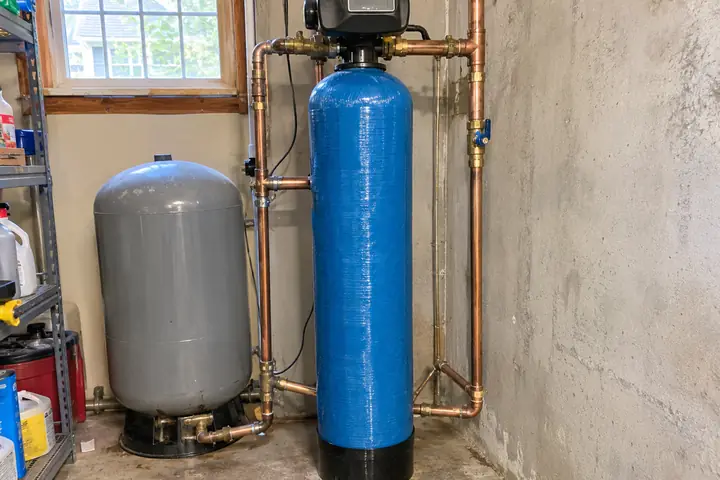
A calcite neutralizer is a corrosion-resistant tank filled with calcite, meaning limestone or marble chips, or a mix of media. Water passes through and picks up enough of the mineral to raise its pH. Virginia's paper calls these acid-neutralizing filters.
How does a soda ash feed differ?
A soda ash feed adds a chemical to the water. Soda ash is sodium carbonate, as both Virginia's paper and the Water Quality Association state. Virginia's paper describes these systems as more complex, and says they "require significant regular maintenance."
| Calcite filter | Soda ash feed | |
|---|---|---|
| What it is | Tank of calcite or mixed media | Chemical feed |
| Lowest pH named | 5.3 | Used below 5.3 |
| Upkeep per the paper | The simpler of the two | "Significant regular maintenance" |
| What goes in the water | Mineral from the media | Sodium carbonate |
Virginia Cooperative Extension BSE-259; WQA on acidity
Which one is my well likely to need?
Your report decides, and a large share of area wells fall near or below the line. NJDEP's Pinelands numbers through March 2014 show how that goes.
Set those side by side and the point is plain. The 32.2% below pH 5 are already past the limit Virginia names for calcite. Those are Pinelands figures, so use them as a sense of the area. Use your own report for your own house, and read the story on acid water and copper for why any of this matters to your plumbing.
What about sodium and hardness?
Ask. Soda ash is sodium carbonate, and this story prints no figure for the sodium a feed adds. Anyone on a sodium-restricted diet should raise it with a doctor and have the treated water tested for sodium.
On calcite, ask the seller what the unit will do to your hardness, and have a lab check it afterward.
Can I test the water after it goes in?
You should, and the state sale rule has a wrinkle worth knowing. Under N.J.A.C. 7:9E-2.3, a sale test samples untreated water, with treatment disconnected or the sample drawn ahead of it. So a neutralizer will not change the pH on a report taken for a sale. It also means the sale report says nothing on whether your equipment is doing its job. For that, order a separate test of the treated water, and include pH, copper and lead if those were your concerns.
Who checks the people selling these systems?
Nobody at the state level, as far as the health department describes it. Its January 2023 page lists "no State regulations for water treatment professionals." Sellers vary, and the lab report is the part you can rely on.
Before signing, ask the seller:
- What pH did you design this for, and did you read my lab report?
- What does the upkeep involve, how often, and who does it?
- What will this do to sodium and hardness in the water?
- Which lab test will show that it worked?
Plumbing connections on any install fall under the same state licensing rule as other plumbing work. Our permit brief covers what to ask your town, and our hiring page covers the license.
Also asked
Does a neutralizer remove anything else?
Neither source lists gross alpha, PFAS or mercury removal for these units. Those lines on a report need their own answer, and gross alpha and radium has one of its own.
Does a neutralizer fix lead I already have in the plumbing?
It addresses the water's corrosiveness, which NJDEP's form names as one answer to lead from home plumbing. A retest is how you find out.
Is low pH a violation I have to fix?
On a private well in New Jersey, pH is a secondary limit and the state's Act works as a right-to-know law. New wells are a different case. State slides say the local health agency "shall require treatment when" a new well's water exceeds a standard.
Will town water end the question?
Where it is available, connecting is on the state's list of options. See switching from a well.
Who to ask
- A New Jersey certified laboratory: ask for a test of treated water from after the equipment, including pH.
- Ocean County Health Department: ask how treatment affects a sale or rental certification.
- Your local construction office: ask what permit the install needs.
Where this comes from
- Virginia Cooperative Extension BSE-259 - calcite filters, pH 5.3, soda ash feed and upkeep. A Virginia source on general chemistry.
- WQA on acidity - soda ash is sodium carbonate.
- NJDEP Private Well Testing Act talk, 2015 - Pinelands pH percentages.
- N.J.A.C. 7:9E-2.3 - sale samples are untreated water (text on Cornell's Legal Information Institute).
- NJDOH Private Wells Drinking Water Facts, January 2023 - no state regulations for treatment professionals.
- NJDEP Private Well Water Test Reporting Form - lead options.
- NJDOH presentation, October 2022 - new-well treatment wording.