Go on town water and you still have a well to deal with
Switching from a well to town water takes three separate decisions: whether a main reaches you, what becomes of the old well, and whether any well line stays. State rules cover the last two, and your utility answers the first.
Compiled from the sources listed at the end. Sources checked .
For houses on a water utility, in Lacey & Forked River, Waretown & Ocean Township, Barnegat, Stafford & Manahawkin, Toms River.
State agencies list this move as one choice among several, and whether it is open to you depends on your street. Prices differ by utility and by lot, so this story gives none.
Why do owners make the switch?
The state health department's private well FAQ lists connecting to public water among the options when contaminants are found, alongside retesting, treatment, a new or deeper well and septic repair. NJDEP's radium handout for South Jersey also lists a public water hookup, if one is available.
The water chemistry is the other pull. In NJDEP's Pinelands data, which runs through March 2014, 78.7% of the 12,510 wells sampled fell outside the pH 6.5-8.5 range, almost all on the low side, which is the subject of our story on acid water and copper. For comparison, Lacey MUA's 2025 data puts pH at 7.30 to 7.90. That is one system, and yours may differ, so read your supplier's report before you compare.
Is the main close enough to reach you?
Only the utility can say, so start there and ask before anything else. Give the address, ask whether a main runs along your frontage, and ask what the utility requires of a new customer.
Ask also where its responsibility stops. Stafford's page puts that point at the curb stop or meter pit. Owners carry what lies past it. That tells you which run of pipe on your own land you would be paying for.
Can a well stay connected to the house?
Not without a state physical connection permit and approved protection. Under N.J.A.C. 7:10-10.2(a), a facility with an unapproved water supply such as a well must have that permit and an approved installation at each connection to a public community water system. The same goes where dual, physically separate lines run in one building. The rule has exceptions in a later section, so ask before assuming yours is covered either way.
The concern is well water getting back into the public main. Plumbing the two together with a simple valve is the arrangement this rule is there to control.
| What you do | What the rule says | Who to ask |
|---|---|---|
| Stop using and abandon it | Owner must have it decommissioned, by or under a driller of the proper class | Well driller, NJDEP |
| Keep it apart for irrigation | If it connects to public water or shares a building with it, permit and approved protection apply | NJDEP, your utility |
| Keep it connected as a backup | Permit and approved installation at each connection | NJDEP, your utility |
N.J.A.C. 7:10-10.2 and 7:9D-3.1, text on Cornell's Legal Information Institute, read November 3, 2026
What must happen to an abandoned well?
It must be decommissioned. N.J.A.C. 7:9D-3.1 puts the duty on the owner when a well is abandoned, destroyed, lost or a threat to groundwater, and says NJDEP may order it, including when a well is replaced.
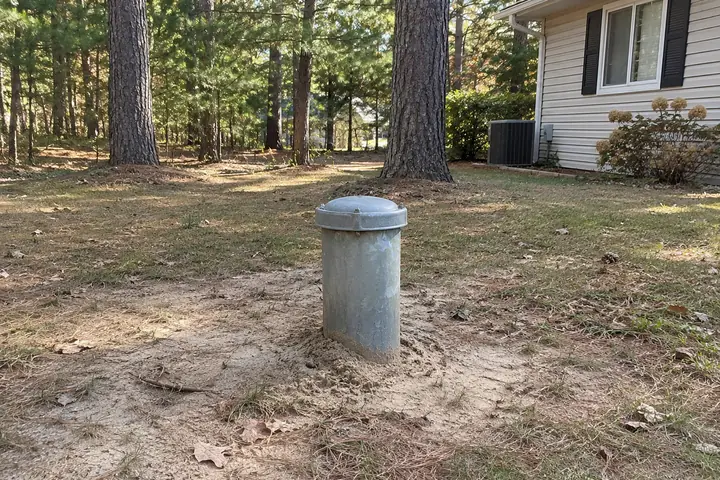
The work has its own named workers: "All wells and boreholes shall be decommissioned by, or in the presence of and under the onsite supervision of, a well driller of the proper class." A well is a direct path into the aquifer, so this is a job for that license. Until then, another section of the rule has the casing kept "securely capped."
Can you keep the well for the lawn?
You may be able to, with the old line fully separated or protected as the state requires. The permit rule above still applies where the well touches public water or sits on dual lines in one building. Ask NJDEP what counts on your layout and have the answer in hand before the plumber arrives. County advice on testing remains in force for a well you keep: the health department calls your private well "YOUR responsibility."
Who does the new connection?
A licensed plumber does the permit work inside the lot, under the state's licensing rule, which sets aside owners working on their own single-family homes. See our story on permits. Service line work is no place for a weekend project, whatever the exception allows. Street valves belong to the utility, so leave them alone.
Also asked
Do I have to retest the water after switching?
The utility tests its own system and publishes the results yearly. Pipes in your house may still react differently to new water, so ask a plumber whether old acid-water damage is worth a look.
Will my softener or neutralizer stay useful?
Treatment chosen for well water may not suit town water at all. Check your supplier's report for pH and hardness first, then ask whoever services the equipment.
Does switching affect the test at a future sale?
The Private Well Testing Act attaches to property with a private well. If a well is still in service or still on the lot, ask the county health department what applies before you list the house.
Is there help paying for it?
The state health department's January 2023 FAQ describes a no-interest New Jersey Housing and Mortgage Finance Agency loan of up to $10,000 for water above primary standards. Ask the agency whether a hookup qualifies.
Who to ask
- Your water utility: whether a main reaches your frontage, new-customer requirements, and where its pipe ends.
- New Jersey Department of Environmental Protection: the physical connection permit and well decommissioning rules.
- Ocean County Health Department: testing and certification for any well you keep.
- Your town's construction office: the plumbing permit for the new line.
Where this comes from
- NJ Department of Health private wells FAQ, January 2023 - options after a failed test, 12%, loan.
- NJDEP radium handout, rev. April 2004 - public water hookup as a fix.
- N.J.A.C. 7:10-10.2 - physical connection permit (text on Cornell's Legal Information Institute).
- N.J.A.C. 7:9D-3.1 - decommissioning duty and who does it (text on Cornell's Legal Information Institute).
- N.J.A.C. 7:9D-2.2 - capping (text on Cornell's Legal Information Institute).
- N.J.A.C. 5:23-2.15 - licensed plumbing work (text on Cornell's Legal Information Institute).
- NJDEP Procopio talk, January 21, 2015 - Pinelands well pH.
- Lacey MUA 2026 report - pH of one public system.
- Stafford Water & Sewer page - curb stop boundary (archived copy).
- Ocean County Health Department, Well Testing - owner responsibility.