A well must be tested before a sale can close
The New Jersey Private Well Testing Act makes a water test a condition of selling a house with a private well. Buyer and seller must both review the results before closing, and landlords must test at least once every five years.
Compiled from the sources listed at the end. Sources checked .
For houses on a private well, in all our towns.
The law is P.L.2001, c.40, and the state health department says it became effective in September 2002. Ocean County adds its own step on top, and the two do not run on the same clock.
What does the law require at a sale?
Every contract of sale for a property with a private well must include testing of that water supply "as a condition of the sale." The Act also reaches wells with under 15 service connections, or wells that do not regularly serve 25 people on 60 days a year.
The closing clause is plain: "Closing of title... shall not occur unless both the buyer and the seller have received and reviewed a copy of the water test results." Both sides certify that in writing at closing.
What does an Ocean County test cover?
An Ocean County test covers the statewide list plus mercury, and it does not carry uranium. The state rule names nine counties for the mercury add-on, Ocean among them. Uranium goes to a different group of counties, mostly in the north.
Older state papers treat arsenic as a northern item and gross alpha as limited. The rule as now written lists both statewide, so expect both on your report.
| Item | Note |
|---|---|
| Total coliform | E. coli if positive |
| Nitrate, iron, manganese, pH | Statewide |
| Volatile organic compounds | All that carry a federal limit |
| Lead, arsenic | Statewide |
| Gross alpha | By 48-hour rapid test |
| 1,2,3-trichloropropane, ethylene dibromide, 1,2-dibromo-3-chloropropane | As of March 3, 2019 |
| PFNA, PFOA, PFOS | As of December 1, 2021 |
| Mercury | County add-on, applies in Ocean |
| Uranium | Not required in Ocean |
N.J.A.C. 7:9E-2.1, as amended through June 1, 2020, read on Cornell's Legal Information Institute
Our line-by-line story on the report sets the limits beside each of these, and PFAS and gross alpha get their own pages.
Who can take the sample, and from which tap?
Only a New Jersey certified laboratory or its authorized representative may sample. The person reading pH must be a lab employee, and a lab certified for those items does the analysis.
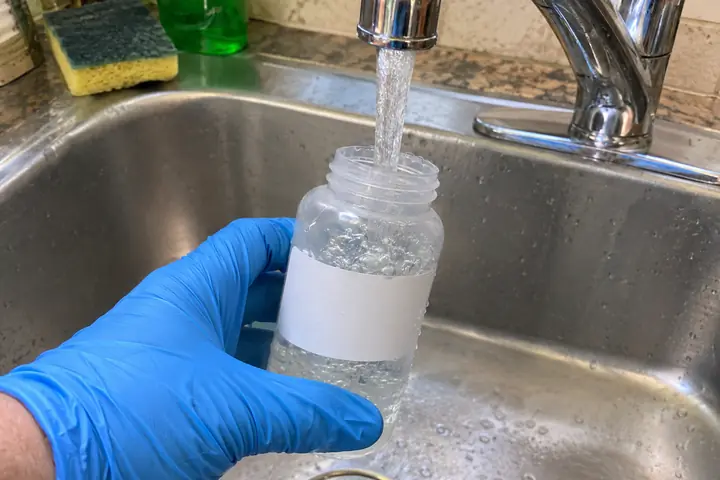
The water must be untreated. Any softener or filter gets disconnected or disabled, or the sample is drawn ahead of it, from a primary cold tap with no aerator. The lead sample comes after at least two minutes of flushing.
The lab then has five business days after finishing the analyses to report on NJDEP's form, and it files with NJDEP electronically. The short video on this page comes from Minnesota's health department and is useful on bottle handling, but the schedule in it is Minnesota's.
Does a bad result stop the sale?
State law requires review of the results; it does not itself require a repair. An NJDEP scientist put it this way in a 2015 talk: "No action required if a parameter limit is 'exceeded' (a right-to-know law)."
That is not the whole answer in this county. The Ocean County Health Department says Ordinance 94-1 "also requires full testing and certification by this agency for drinking water standards" at a real estate transaction, before a rental, and before a Certificate of Occupancy where the town requires one. That wording is the department's; we have not seen the ordinance itself. Ask the department what its certification step means for your closing, and ask early.
How long does a test stay good?
It depends on who is asking. A state health department presentation from October 2022 gives one year for analytical results and six months for coliform. The county says its certification is "good for 6 months from the date of the test." A listing that sits can outlast a county certification while the state's one-year analytical figure holds.
What do landlords owe their tenants?
A lessor must test at least once every five years and, within 30 days of getting results, give a written copy to each rental unit. Each new tenant gets the most recent results. The county agrees on five years and adds that testing "must occur prior to occupancy of a tenant."
What does it cost, and who hears about a failure?
The state health department put the average at $1,250 as of January 2023. The same page describes a no-interest state loan of up to $10,000, the NJHMFA Potable Water Loan Program, for water above primary standards, as of that date.
Results do travel. On an acute failure the lab must tell the person who ordered the test and the local health authority within 24 hours. For any failure, NJDEP notifies the local health authority within five business days.
Also asked
Can my neighbors find out that my well failed?
Not from the state by address. Results are confidential, and public compilations carry no addresses. A county or local health officer may send nearby well owners a general notice suggesting they test, without identifying the failed well, and that is at the agency's sole discretion.
Does a house with a treatment system get tested on treated water?
No. The rule calls for untreated water, so the result describes the well and leaves your equipment out of it. A separate test after the treatment is your own choice, and often a sensible one.
Is there a test requirement when no one is selling or renting?
The Act's triggers are sale and lease. The county still advises testing every year for bacteria and nitrates and at least periodically for the full range, and it says plainly that your well "is YOUR responsibility."
Can a family member collect the bottles to save money?
The rule says the lab or its authorized representative does the sampling. A homeowner's own bottle does not meet it for a sale.
Does every buyer on a well in Ocean County face this?
Every contract of sale for a property with a private well falls under the Act's main clause. The state counted 5,131 sampled wells in Ocean County from September 2002 to March 2014, with Jackson Township alone at 1,528.
Who to ask
- Ocean County Health Department: ask what Ordinance 94-1 certification involves for your sale or rental, and how the six months is counted.
- NJDEP: ask about the state's reporting form and certified lab requirements.
- New Jersey Housing and Mortgage Finance Agency: ask if its loan is still offered and on what terms.
Where this comes from
- P.L.2001, c.40, New Jersey Legislature - sale, closing, lease, notice and confidentiality clauses (archived copy).
- N.J.A.C. 7:9E-2.1 - statewide items, mercury and uranium counties (text on Cornell's Legal Information Institute).
- N.J.A.C. 7:9E-2.3 - untreated sample and lead flush (text on Cornell's Legal Information Institute).
- Ocean County Health Department, Well Testing - Ordinance 94-1, six-month certification, tenant rule.
- NJDOH presentation to local health departments, October 3, 2022 - validity periods.
- NJDOH Private Wells Drinking Water Facts, January 2023 - effective date, average cost, loan program.
- NJDEP, Private Well Testing Act talk, January 21, 2015 - right-to-know description, Ocean County well counts.