New Jersey's plumbing permit rule, and the short list of jobs outside it
You need a plumbing permit in New Jersey for most work beyond ordinary maintenance. The state code at 5:23-2.14 bars constructing, repairing, altering or installing regulated equipment without one, and sets aside ordinary maintenance and emergencies.
Compiled from the sources listed at the end. Sources checked .
For any Ocean County house, in all our towns.
The rules are state rules, and your town's construction office applies them. Four questions matter here: what requires a permit, what counts as ordinary maintenance, who may do the work, and what goes on the application. This story uses the state's wording where we could.
Which jobs need no permit?
Those on the state's ordinary plumbing maintenance list need none. Section 5:23-2.7 spells it out, and the conditions in the right column below are part of the rule.
| Job | Condition in the rule |
|---|---|
| Replacing hose bib valves | With an approved vacuum breaker |
| Refinishing fixtures | None stated |
| Replacing ball cocks | Anti-siphon type |
| Repairing leaks | Includes replacing piping |
| Clearing stoppages | None stated |
| Replacing faucets or working parts | None stated |
| Replacing valves and traps | None stated |
| Replacing a fixture | With a similar one, no piping change |
| Replacing clothes washers and dishwashers | Domestic machines |
N.J.A.C. 5:23-2.7, text on Cornell's Legal Information Institute, read November 3, 2026
The list is narrower than it first looks. Moving a sink, adding a bathroom or changing the piping behind a fixture falls outside it. So does anything else not named, so when in doubt, ask before you open the wall.
Is a water heater swap on that list?
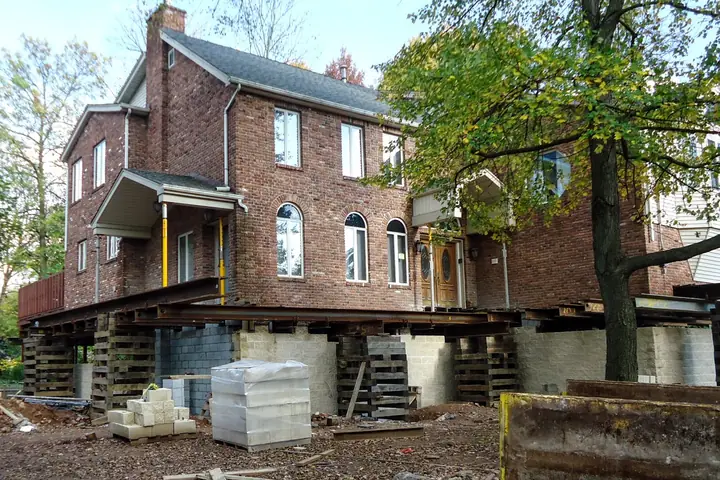
No, so do not treat it as permit-free. Water heater replacement does not appear on the state's plumbing maintenance list. Ask your construction office before the old one comes out. On a raised house, ask as well about location, which our story on water heater placement covers.
What happens when a pipe bursts at night?
Close your own main valve if it sits somewhere dry, stay out of water near electrical gear, and call a licensed plumber. The paperwork comes after. Section 5:23-2.14 makes room for emergency work: give notice as soon as practicable and apply within 72 hours. Many leak repairs are on the ordinary list anyway and need no permit at all.
The same section sets a middle category. Minor work still requires a permit but may start on notice, so ask your office whether your job qualifies.
Can a homeowner do the work without a license?
Yes, on a narrow footing. Section 5:23-2.15 says plumbing work "shall not be undertaken except by persons licensed to perform such work pursuant to law," with one exception: the "single-family homeowner on his or her own dwelling."
Rental units, condominiums or a relative's house are questions to take to the office before assuming anything. So is whether you must personally do the work, since the state text gives only that exception. It concerns who may do the job, so ask your office what permit steps still apply.
What goes on the permit application?
The name and license number of the plumbing contractor go on it, and the licensed contractor's seal and signature go on the subcode form. If someone offers to pull a permit in your name so that a license need not appear, take that as a reason for caution. Our story on hiring has the questions to ask.
Are wells and septic systems handled the same way?
No. They run on separate rules through separate offices. Under the septic rule, "A person shall not construct, install, repair or alter" a septic system until the administrative authority has issued a permit, and that authority is the board of health or its agent; see who approves septic work. A new well needs sign-off from local health before the rig arrives and a test by a state-certified lab once it is finished, says a 2022 state health presentation. Connecting a house with a well to public water has a permit of its own, set out in our story on switching.
Flood zones add another layer. A FEMA advisory says plumbing fixtures are not allowed below base flood elevation, a point our story on what changed under raised houses takes up.
Also asked
Can I replace my own kitchen faucet without a permit?
Yes. Replacing faucets or their working parts is on the state's ordinary maintenance list.
Does a clogged drain count as permit work?
No. Clearing stoppages is on that list, whoever does the clearing.
Can I swap a toilet for a new one?
Replacing a fixture with a similar one and no piping change is on the list. If the swap means moving the drain, it no longer fits that wording.
Who decides if my job is ordinary maintenance?
Your town's construction office is the place to ask. Ask before work starts, while the walls are still open.
Who to ask
- Your town's construction office: whether a job needs a permit, whether it counts as minor work, and how the homeowner exception is applied.
- Ocean County Health Department: septic plan review, and anything about your well.
- NJDEP: permits for wells and physical connections.
Where this comes from
- N.J.A.C. 5:23-2.14 - permit requirement, emergencies, minor work (text on Cornell's Legal Information Institute).
- N.J.A.C. 5:23-2.15 - licensed work and homeowner exception (text on Cornell's Legal Information Institute).
- N.J.A.C. 5:23-2.7 - ordinary maintenance list (text on Cornell's Legal Information Institute).
- N.J.A.C. 7:9A-3.5 - septic permit (text on Cornell's Legal Information Institute).
- N.J.A.C. 7:9A-3.12 - temporary holding tanks (text on Cornell's Legal Information Institute).
- NJ Department of Health presentation, October 3, 2022 - new well certification.
- FEMA Region 7 advisory on building utilities - fixtures below base flood elevation.