A raised house puts its water lines out in the cold
Freezing pipes under a raised house are a matter of exposure: water lines in open air have less around them than lines inside a wall. The Red Cross advice still applies. Let cold water drip in a hard freeze, keep the heat steady, and never put a flame on a frozen pipe.
Compiled from the sources listed at the end. Sources checked .
For houses raised or built up on pilings, in all our towns.
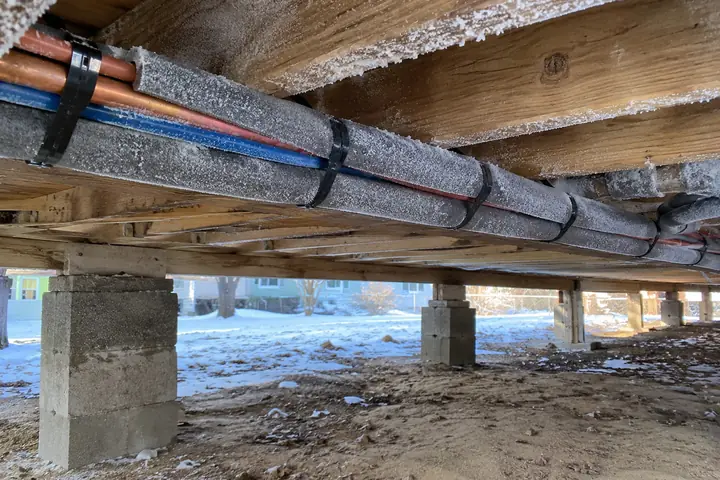
Where is a raised house most exposed?
Anywhere water stands in a line outside the heated part of the house. The table below is this site's own reading of the Red Cross and Toronto advice, applied to the way a house on piers or block is laid out.
| Spot | Why it matters | What to ask or do |
|---|---|---|
| Line rising from the ground to the floor | Open air on all sides | Ask a plumber about pipe covers |
| Run along the underside of the floor | Sits below the heated room | Look for gaps in insulation |
| Outdoor tap on a post or wall | Water stands at the end of the line | Toronto says shut off, drain, remove hoses |
| Kitchen or bath sink on an outside wall | Cabinet doors keep warm air out | Open the doors in a freeze |
Red Cross frozen-pipe steps (archived copy, read 2026) and City of Toronto video (2022), matched to a raised house by this site
What does the Red Cross say to do?
Four things, from its frozen pipes page (archived copy):
- Open cabinet doors so room air reaches the pipes.
- When it is very cold, "let the cold water drip" from a tap.
- Keep the thermostat the same day and night.
- If you use heat tape, use only UL-listed heat tape, installed as its maker directs.
Why no flame, ever?
Because a torch under a house is a fire waiting to happen. The Red Cross rules out a blowtorch, kerosene or propane heater, charcoal stove or any open flame on a frozen pipe. On a raised house, that flame would sit against framing, insulation and the underside of the floor you sleep on.
Is heat tape a homeowner job under a raised house?
Not without asking first. Heat tape needs power, and FEMA's Region 7 advisory says electrical below the Base Flood Elevation is allowed only if needed for life safety. That document was written for Iowa, so ask your town how it reads here. Adding an outlet or circuit under the house is work for a licensed electrician, and any heat tape on the line should be UL-listed and installed as its maker directs.
Pipe covers raise fewer questions. Foam is on the list of steps in the Toronto video, and it does not plug into anything. Before you buy, remember that insulation down there can get wet in a flood, and a plumber who has seen your lines can say what suits them.
Can you close up the flood openings for winter?
No. Sealing air leaks is good general advice for a house, but the openings in an enclosure's walls are there for floodwater and must stay working. Our flood openings story explains why. Keep the insulation on the pipe and the opening clear.
What does the Toronto video add?
The video on this page comes from the City of Toronto, and its list is useful with a caveat: its pencil-thin stream is pegged to minus 15 Celsius, and it assumes a basement water meter, which many Ocean County homes do not have. Its main steps are to drain outdoor taps, keep the whole house warm, find and label the main shutoff, cover exposed pipes and seal drafts.
What is the plan if a pipe bursts?
Find your main shutoff now, while nothing is wrong, and label it. On a raised house it could be upstairs, in the enclosure or on a riser, so walk the line and find out. Then:
1. Close the house's main valve, if it sits somewhere dry. 2. Stay out of standing water near electrical equipment. Ready.gov's warning about wet electrical gear applies here too. A breaker is only worth trying from dry footing. 3. Call a licensed plumber. A leak repair that replaces piping is on New Jersey's ordinary maintenance list. 4. Leave any valve in the street alone. Those are the utility's to operate, and our curb stop story explains where its side ends. Call the water utility if you cannot stop the water from your side.
Also asked
Should I leave a tap dripping all winter?
The Red Cross ties its drip advice to very cold weather without setting a temperature. Toronto's number is Toronto's.
Does a raised house on the bay freeze less than one inland?
We found no source that answers this for Ocean County. Wind, sun and the line's route all differ house to house, which is reason enough to walk your own lines.
Do I need a permit to add pipe insulation?
Insulation is not on the ordinary maintenance list, which is about plumbing parts. A question to the construction office settles it quickly.
Who pays if a line freezes between the street and the house?
It depends on your utility. Stafford's page, for one, puts the township's duty at the curb stop or meter pit and leaves the rest to the owner. Ask your own utility where its side ends.
Who to ask
- A New Jersey licensed master plumber: pipe covers, rerouting an exposed run, or a frozen or burst line.
- A licensed electrician: any outlet or circuit for heat tape under the house.
- Your water utility: where its side of the line ends.
- Your municipal construction office: whether a line move needs a permit.
Where this comes from
- American Red Cross, Frozen Pipes (archived copy) - cabinet doors, drip, thermostat, UL-listed heat tape, no open flame.
- FEMA Region 7, Flood Protection and Elevation of Building Utilities, 2016 - electrical below the Base Flood Elevation.
- Ready.gov, Floods - wet electrical equipment.
- N.J.A.C. 5:23-2.7 - ordinary plumbing maintenance (text on Cornell's Legal Information Institute).
- N.J.A.C. 5:23-2.14 - emergency work (text on Cornell's Legal Information Institute).
- Stafford Township Water & Sewer (archived copy) - who is responsible beyond the curb stop or meter pit.