After a flood, leave the septic tank alone until the field drains
Septic after a flood needs patience. EPA says not to pump the tank while the drainfield is flooded, to plug basement drains and cut water use hard, and to hold off using the system until the field has drained.
Compiled from the sources listed at the end. Sources checked .
For houses on septic or sewer, in all our towns.
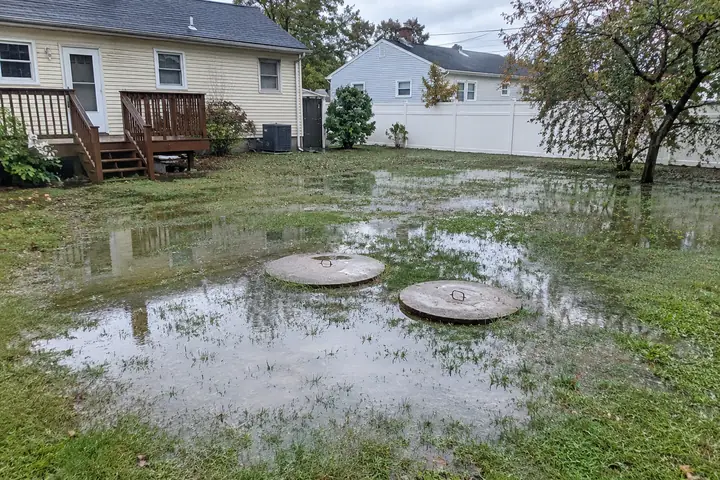
EPA's question-and-answer page offers some comfort at the start: "Most septic tanks are not damaged by flooding since they are below ground." It also warns that tanks can fill with silt. So the likely problem is water with nowhere to go, and a bad decision can make it worse.
Should you pump the tank right away?
No. In EPA's words, a tank pumped while the field is under water might "try to float out of the ground." The instinct to empty a full tank is strong after a storm, but a full tank is heavy and an empty one in waterlogged ground is the one EPA worries about. Wait for the water to fall first.
When can you use the system again?
EPA's test is the field itself: soil water out there has to drop below the water around the house. Until then, every flush and shower is heading to a field that cannot take it. Plug basement drains if you have them, and cut water use drastically.
A raised house has no basement drain to plug, but the other half of the advice holds. Our story on what to do before you restart anything covers the rest of the house.
What about a system with a pump or alarm panel?
Treat the electric parts as live. Some systems have a pump, control panel or alarm, and those are for a licensed electrician or septic professional once water has touched them. A breaker check is fine only from dry ground, never from a wet floor. Ready.gov's advice is to leave wet electrical equipment alone, and to touch nothing electrical while you are in water.
The video on this page, from an Oklahoma State University water specialist in 2019, repeats the same plain steps: plug drains, limit water, get a professional inspection, and leave opening the system to professionals because of the fumes. It assumes basements and pumped systems and does not say how to shut power off safely, so the advice above stands where the two differ.
How do you know the flood did damage?
You often cannot tell from the lawn, which is why EPA says to have the system professionally inspected if you suspect damage. Silt in the tank will not show from above. The state's signs of malfunction give you something to watch for once water recedes: pooled sewage outside, seepage into a room below ground, or a drain that backs up though nothing blocks it.
Any of those puts a duty on the owner to tell the local authority right away, and repairs wait for its approval. Our story on who approves septic work explains the steps.
| What you see | What it may mean | First step |
|---|---|---|
| Slow drains while yard is wet | Field still flooded | Cut water use and wait |
| Sewage on the ground | Malfunction sign in the rule | Stay clear, notify the authority |
| Sewage in a low room | Malfunction sign in the rule | Stay clear, stop using drains, licensed pro |
| Back-up with no blockage | Malfunction sign in the rule | Notify the authority |
Drawn from EPA's flood Q&A and N.J.A.C. 7:9A-3.4; the middle column is this site's plain reading
Does rebuilding after a storm mean a new septic system?
It need not. The state makes room for an existing system after a catastrophe: it can remain if a licensed professional engineer, acting as the septic designer, puts in writing that it works and complies. Without that paper the exception does not apply, so ask the board of health what comes next.
What if your well flooded too?
Then the well needs its own steps, and the first is simple. EPA's septic page says, "Do not drink well water until it is tested." A flooded field near a flooded well is the pairing that makes this urgent. EPA's separate well sheet also says not to turn on the pump until wiring has been checked, and our well story goes through it.
Also asked
Can I run the washing machine once the yard looks dry?
A dry surface does not settle it. If in doubt about the field, ask whoever inspects the system, and keep loads small until then.
Will my tank really float?
EPA raises the risk for a tank pumped while the field is flooded, and gives no odds. Since you can avoid the risk just by waiting, that is the sensible course.
Should I add anything to the tank after a flood?
We found no agency advice telling owners to add anything. Ask the licensed professional who inspects it.
Who inspects a flooded system?
EPA says a professional. Since New Jersey repairs need local approval, ask the board of health who it expects to see on the job.
Who to ask
- Your town's board of health: report sewage on the ground or in the house and ask about repair approval.
- Ocean County Health Department, Consumer Health: ask where to direct septic questions after a flood.
- Your electric utility or a licensed electrician: ask before anything wet is powered up.
Where this comes from
- EPA, Septic Systems: What to Do After the Flood - pumping, drains, water use, inspection.
- N.J.A.C. 7:9A-3.3 - existing system after a catastrophe (text on Cornell's Legal Information Institute).
- N.J.A.C. 7:9A-3.4 - malfunction signs and notice (text on Cornell's Legal Information Institute).
- N.J.A.C. 7:9A-3.12 - holding tanks (text on Cornell's Legal Information Institute).
- EPA, How to Care for Your Septic System - inspection schedule.
- Ready.gov, Floods - wet electrical equipment.
- National Hurricane Center, Sandy report - storm tide in Ocean County.
- OSHA, hydrogen sulfide in workplaces - septic tank work exposure.